
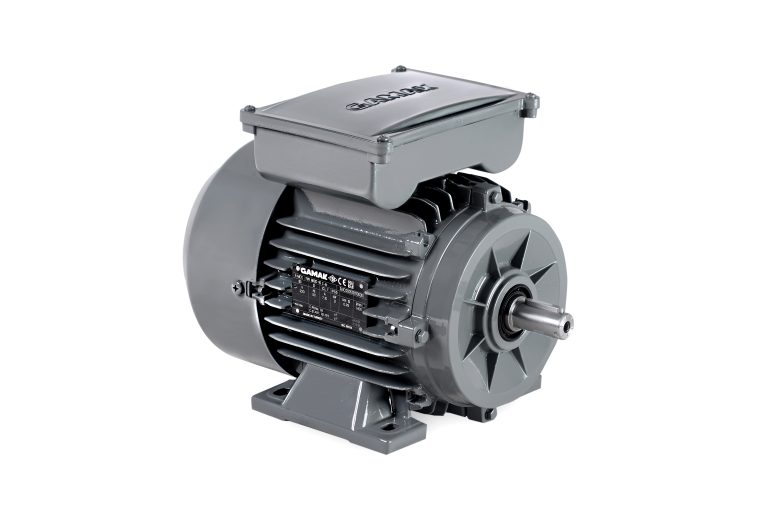
Single-phase asynchronous electric motors
Electric motor series: Aluminum housing version MS22, MK22 series
Available power: 0.18 kW – 3 kW
Operating mode: S1
Frequency: 50 Hz
Nominal voltage: 220V
Insulation class: F
Protection degree: IP55 (standard), IP56, IP65, IP66 (additional options)
Output speed of electric motors, rpm: 3000, 1500
Efficiency class: IE2 (high efficiency)
Mounting position:
– B3 foot mounting
– B5 flange mounting (large flange)
– B14 flange mounting (small flange)
– B35 foot-flange version (large flange)
– B34 foot-flange version (small flange)
Motor options:
- – Forced motor cooling
- – Motor heating
- – Winding protection against overheating 3xRTS, 3xPT100
- – Bearing protection 2xPT100 DE&NDE
- – Metal cable glands
- – Tropical version
Single-phase motors meet the same standards as three-phase motors. In single-phase motors, the rotating field that provides the motor torque is created by two separate windings, called the main and auxiliary windings. Depending on the application, these motors can be selected with a permanent capacitor or with a circular + permanent capacitor.
Types of single-phase induction motors
Single-phase induction motors are divided into two main groups depending on the torque requirement: permanent capacitor or start + permanent capacitor.
Gamak single-phase electric motors classify permanent capacitor motors as the M21D series, and start + permanent capacitor motors are classified as MS21D “electronically wound” and MK21D “mechanically switched”.
The choice of motor type depends on the variety of applications, the type of starting load and the torque requirements under load. The M21D series can be used in applications with low torque requirements, such as fan units. For applications with high torque requirements, such as cranes and compressors, the MS21D or MK21D series can be used.
Working Principle of Single-Phase Asynchronous Motors
Single-phase asynchronous motors cannot easily generate a magnetic field like three-phase asynchronous motors. In single-phase asynchronous motors, an auxiliary winding is added to the main winding to create a phase difference and generate a magnetic field for the motor to rotate. Single-phase motors use capacitors to provide additional starting torque and help the motor reach its rated speed under load.
Structure of Single-Phase Asynchronous Motors
The structure of single-phase asynchronous motors is almost the same as the mechanical structure of three-phase asynchronous motors. The capacitor bank, terminal connection diagram, and the use of a mechanical switch or an electronically wound structure are the distinctive features of single-phase asynchronous motors.